

Orlando Tanker Truck Accident Lawyer
Hazmat, Fuel, Chemical & Food-Grade Tanker Crash Attorneys in Orlando
Hazmat, fuel, and chemical tanker truck crash representation under federal HMR/49 CFR rules and Florida law. Serving Orlando, Orange County, and all of Florida.
When Cargo Itself
Is the Danger
Federal Hazmat Regulation Expertise
Tanker and hazmat truck crashes in Orlando are governed by 49 CFR Parts 100–185 — the federal Hazardous Materials Regulations. HOV Law applies the full federal framework — placarding, routing, training, and emergency-response requirements — to identify every regulatory violation that supports your civil claim.
Rollover and Cargo-Spill Cases
Tanker trucks have an inherently high center of gravity and unique "surge" dynamics that make rollovers and spills disproportionately common on I-4, the Florida Turnpike, and SR 417 exit ramps. HOV Law retains accident reconstruction engineers who specialize in tanker crash dynamics.
Multi-Defendant Hazmat Liability
A tanker crash exposes a layered defendant universe — the carrier, the shipper of the cargo, the hazmat training provider, the loading facility, and (where applicable) the manufacturer. HOV Law identifies every responsible party at the outset.
Orlando's Hazmat
Tanker Truck Risk
Fuel tankers serving Orlando-area gas stations and MCO airport jet-fuel operations, chemical tankers running between Tampa's port and South Florida via I-4, propane and natural gas tankers serving Orlando residential and commercial accounts, and food-grade tankers supplying Central Florida's dairy, beverage, and food-processing industries — all combine to put a constant stream of hazmat-classified tanker trucks on Orlando's busiest roads.
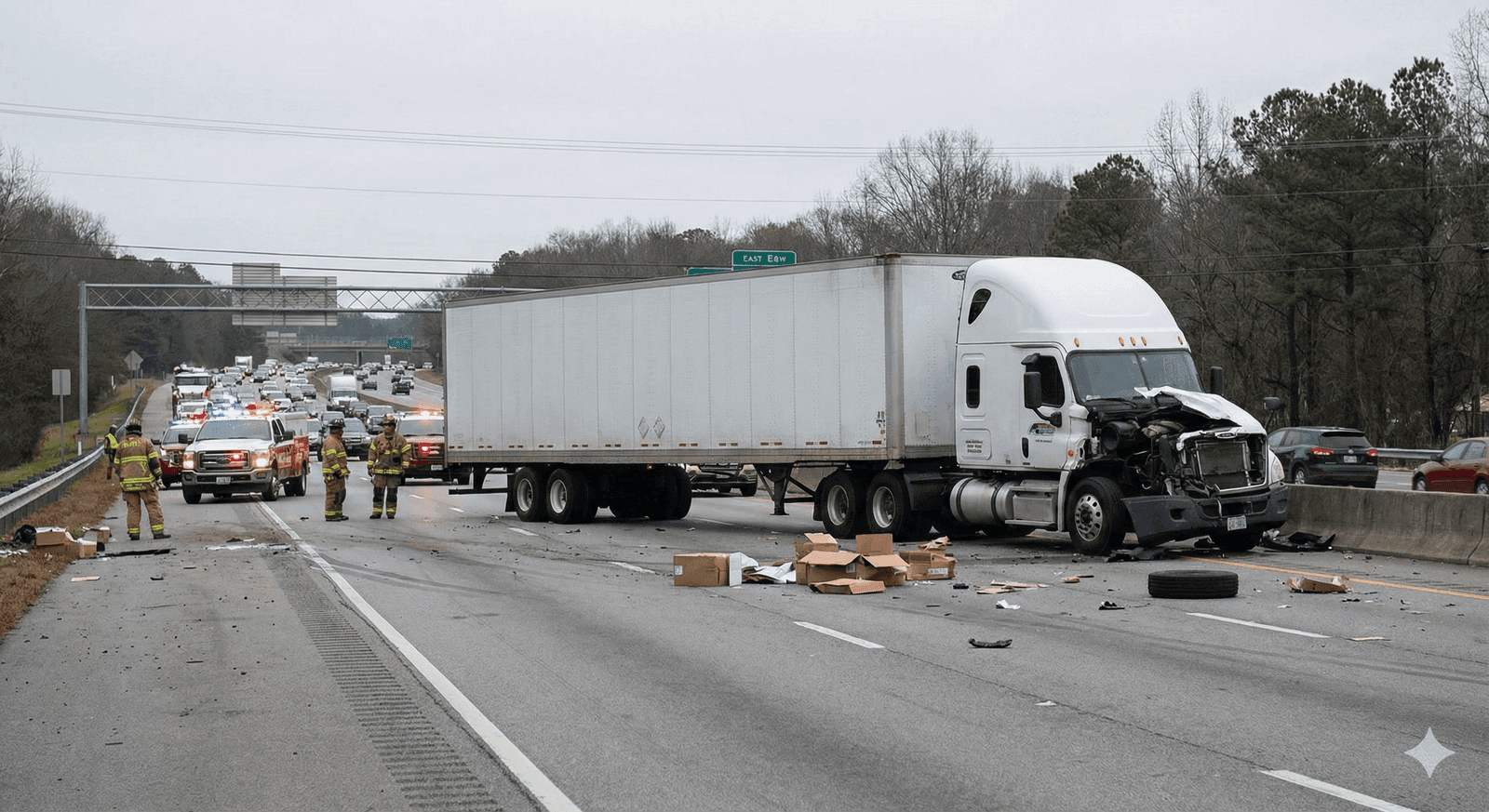
Orlando Tanker Truck Accident Lawyer — Hazmat and Specialty Cargo Crashes
Tanker truck accidents are different. A tanker carrying 8,000 gallons of fuel, a corrosive chemical, liquefied propane, or even a food-grade liquid presents risks that no ordinary commercial truck does. Beyond the impact of the crash itself, the cargo can ignite, explode, burn skin on contact, contaminate adjacent property, force evacuations of entire neighborhoods, and produce inhalation injuries to victims and first responders. The legal framework is correspondingly more complex.
Call HOV Law at (407) 801-0101 for a free consultation with an Orlando tanker truck accident lawyer — available 24/7.
Types of Tanker Trucks on Orlando Roads
- The "tanker" category covers vehicles with very different cargos, regulatory frameworks, and crash patterns:
- Fuel Tankers (Gasoline, Diesel, Jet Fuel)—The most common tanker type on Orlando roads. Fuel tankers run continuously between regional fuel terminals and gas stations across Orange, Seminole, and Osceola counties, plus the jet-fuel operations supporting Orlando International Airport (MCO). Capacity is typically 8,000 to 11,000 gallons. Fuel tanker rollovers and spills produce immediate fire and explosion risks.
- Chemical Tankers—Industrial chemical tankers run I-4 between Tampa's port and South Florida processing and distribution facilities. Loads range from corrosive acids to caustic bases to specialty industrial chemicals. Chemical tanker spills produce burn injuries, inhalation injuries, and environmental contamination claims that compound the underlying motor-vehicle claim.
- Propane and Compressed Gas Tankers—Propane delivery serving residential, commercial, and theme-park accounts across Central Florida. Compressed gas tankers (oxygen, nitrogen, argon) serving medical and industrial users. These pressurized tankers present BLEVE (Boiling Liquid Expanding Vapor Explosion) risks if compromised in a crash.
- Food-Grade Liquid Tankers—Milk haulers serving Florida dairy operations, beverage syrup tankers serving Orlando's soft-drink bottling and theme-park accounts, and edible-oil tankers serving food processors. Even non-hazardous cargo can create roadway hazards when spilled at highway speed, and the food-grade tanker industry is subject to its own FDA and USDA regulatory layer separate from the hazmat framework.
- Crude and Refined Petroleum Tankers—Crude oil tankers are less common in Florida than in producing states, but refined petroleum-product tankers (heating oil, kerosene, fuel additives) run regularly on Florida Turnpike, I-4, and SR 417.
- Water and Wastewater Tankers—Construction site water tankers and wastewater (septic) haulers operate throughout Orange County. Spills from these tankers can produce biohazard exposure claims for affected victims.
Federal Hazmat Regulations — 49 CFR Parts 100 to 185
When a tanker carries hazardous materials, the federal Hazardous Materials Regulations (HMR) at 49 CFR Parts 100 through 185 govern nearly every operational requirement. Each regulation creates a duty whose violation can support a negligence claim in civil court.
Classification and Identification — 49 CFR Part 172 — Hazardous materials are classified into 9 hazard classes (explosives, gases, flammable liquids, flammable solids, oxidizers, toxic substances, radioactive materials, corrosives, miscellaneous) with detailed sub-classes and packing groups. The shipper has primary responsibility for proper classification. Improper classification — typically a shipper failure — can leave the carrier and first responders operating without the safety information they need to respond to a crash.
Placarding Requirements — 49 CFR Part 172 Subpart F — Tankers carrying placardable quantities of hazardous materials must display four placards (one on each side, plus front and rear) identifying the hazard class and UN identification number. Failure to placard, improper placarding, or removed placards create immediate hazards because emergency responders cannot identify what they are dealing with at the crash scene.
Routing Restrictions — 49 CFR Part 397 — Federal law requires certain hazmat shipments to follow designated routes that avoid heavily populated areas, tunnels, and certain bridges. Florida and local jurisdictions impose additional route restrictions on highly hazardous loads. Tankers found operating off the required route at the time of a crash face direct regulatory violation claims.
HM-181 Driver Training Requirements — 49 CFR Part 172 Subpart H — All drivers handling hazmat must receive general awareness, function-specific, safety, security awareness, and in-depth security training, with recurrent training every three years. Carriers must maintain training records under 49 CFR § 172.704. Records that are missing, falsified, or outdated support negligent-training claims.
Hazmat Endorsement and Background Check Requirements — Drivers operating tankers carrying placardable quantities of hazmat must hold a Hazmat Endorsement (HME) on their CDL, requiring TSA security threat assessment and additional knowledge testing. Carriers that knowingly assign hazmat loads to drivers without valid HMEs face direct liability.
Emergency Response Information — 49 CFR Part 172 Subpart G — Tankers must carry shipping papers with emergency response information accessible to the driver and to first responders. Carriers must maintain a 24/7 emergency response telephone number monitored by a person qualified to provide hazard-specific guidance. Failure of this emergency-response infrastructure during an Orlando tanker crash supports independent negligence claims.
Cargo Tank Specification Requirements — 49 CFR Part 178 — Tanker trucks themselves must meet detailed federal cargo-tank specifications (DOT 406, DOT 407, DOT 412, MC 331, etc.) appropriate for the cargo being hauled. Tanks must be tested and inspected on prescribed cycles. Tank-specification failures and missed inspections produce product-liability and maintenance-negligence theories.
Why Tankers Roll — The Physics That Drive Tanker Litigation
Tankers roll at significantly higher rates than other commercial trucks of similar weight class. Understanding why is essential to building a tanker crash case.
High Center of Gravity — Tanker chassis are tall by design — the cylindrical tank shape sits high on the frame to allow gravity drainage and to make room for the running gear underneath. The resulting center of gravity is significantly higher than a flatbed or van trailer of comparable weight. Cornering forces that would not destabilize a lower-CG trailer can roll a tanker.
The Surge Phenomenon — A liquid cargo in a partially full tank moves freely inside the tank. As the tanker accelerates, brakes, or corners, the liquid sloshes — and the moving mass creates dynamic loading that shifts the center of gravity in ways the driver may not anticipate. Surge is most pronounced when the tank is between roughly 20% and 80% full; fully loaded or fully empty tanks behave more predictably.
Baffle Systems and Compartmentation — Modern tanker design uses baffles (perforated walls inside the tank) and compartmentation (separate sealed sections) to reduce surge. The baffle system is mandatory for most non-food cargos. Improperly maintained baffles, or food-grade tanks that cannot use baffles for sanitation reasons, are at heightened surge-rollover risk. The tanker's specific baffle configuration is documented and discoverable.
Driver Training Limitations — A driver trained on dry-van and flatbed operation may have very little experience with the dynamic loading of a liquid load. Carriers that assign drivers to tanker work without adequate specialized training face direct negligence liability when surge-induced rollovers occur.
Florida Exit Ramp Geometry — Many of the I-4, SR 408, SR 417, and Florida Turnpike exit ramps in the Orlando area combine descending grades with tightening radii — geometry that maximizes lateral cornering force on a loaded tanker. The interchange-specific geometry is itself relevant evidence in many tanker rollover cases.
Cargo Spill, Environmental Damage and Tanker-Specific Compensation
Tanker crashes produce categories of injury and damages that simply do not occur in ordinary commercial vehicle cases. Understanding these categories is essential to recovering the full value of an Orlando tanker case.
Chemical Burns — Direct skin contact with corrosive or alkaline cargo (acids, caustics, wet concrete from a cement-mixer tanker, certain industrial chemicals) produces burns that may continue to evolve for days after the initial exposure. Burn injuries require burn-center treatment, frequently at the Orlando Regional Medical Center Burn Center, and often produce scarring, contractures, and long-term reconstructive surgery requirements.
Inhalation Injuries — Vaporized or aerosolized chemical exposure during a tanker crash can produce inhalation injury to victims at the scene and to first responders. Inhalation injuries can be acute (immediate respiratory distress) or delayed (reactive airways dysfunction syndrome, chemical pneumonitis). Long-term respiratory disability claims require detailed pulmonary specialist evaluation.
Evacuation Damages — Tanker crashes involving certain hazmat cargos require evacuation of surrounding properties — homes, businesses, schools, hotels. Evacuated families incur hotel costs, lost work time, and the cost of disrupted business operations. These categories of damages are compensable but require careful documentation.
Business Interruption Claims — Businesses adjacent to an Orlando tanker crash scene that are forced to close during cleanup, decontamination, or road closure can claim business interruption damages from the responsible parties. These claims are often resolved alongside the personal-injury claims of the same incident.
Environmental Cleanup and Third-Party Cleanup Costs — Under federal CERCLA and Florida environmental statutes, the parties responsible for a hazmat release can be liable for environmental cleanup costs incurred by FDEP, the EPA, and private remediation contractors. While these claims are not directly the injured victim's recovery, the cleanup liability is leverage in negotiating the underlying personal-injury claim and signals how seriously the defendant universe will be defending the case.
Shipper Liability Under HMTA — The federal Hazardous Materials Transportation Act and its implementing regulations make the shipper (the party tendering the cargo for shipment) directly liable for proper classification, packaging, labeling, and emergency information. When the shipper's failures cause or worsen a crash, the shipper is a co-defendant alongside the carrier.
I-4, Florida Turnpike, and SR 417 — Orlando's Tanker Truck Corridors
Hazmat tanker traffic in Orlando concentrates on the same major freight corridors that produce most commercial truck crashes — with the added factor that hazmat routing rules push some loads onto specific roads and away from others.
Interstate 4 — The primary east-west freight corridor through Orlando. Fuel tankers serving Orlando-area gas stations, MCO's jet-fuel operations, and theme-park accounts run constantly on I-4. Chemical tankers running between Tampa's port and South Florida's industrial users use I-4 unless specific routing rules direct otherwise. I-4 tanker crashes near the downtown SR 408 interchange or the SR 417 split typically close lanes for extended periods and may require evacuation of surrounding properties.
Florida's Turnpike — Long-haul tanker traffic between Orlando and South Florida uses the Turnpike. The high speed limits and long uninterrupted sections produce a different crash profile — fewer urban congestion crashes, more fatigue-related and tire-related incidents at high speed.
SR 417 (Central Florida GreeneWay) — The toll loop on Orlando's east side carries tanker traffic to and from the airport, the eastern industrial corridor, and the Brevard County space-coast economy. SR 417 tanker crashes near the BeachLine Expressway interchange and the SR 528 interchange are particular concerns.
SR 528 BeachLine Expressway — The connection between Orlando and Port Canaveral / Brevard County industrial operations. Chemical and specialty tanker traffic uses this corridor, particularly for loads associated with Cape Canaveral aerospace and defense operations.
Local Routing Constraints — Orange County imposes some local routing constraints on hazmat shipments to keep them away from densely populated residential areas and certain tourist corridors. Loads operating off the prescribed route at the time of a crash face additional regulatory exposure.
More Orlando injury resources
Data, guides, and the other Orlando matters our attorneys handle.
Orlando Crash Data & Research
Our Injury Intelligence Center publishes original analysis of federal NHTSA fatal-crash records for Orange County — the same data we use when building a tanker & hazmat truck accidents case. Methodology and the raw dataset are published alongside every report.
Florida Legal Guides
In-depth explanations of the Florida statutes, deadlines, and insurance rules that decide these cases — written by our attorneys, free to read, no form required.
Related Practice Areas in Orlando
Tanker & Hazmat Truck Accidents cases often involve overlapping injuries and legal claims. Our Orlando attorneys also handle these related areas:
Other Personal Injury Services in Orlando
Also serving Orlando for Criminal Defense:
Serge Hovhanessian, Esq.
Founding Attorney at HOV Law | Florida Bar | Million Dollar Advocates Forum | Top 40 Under 40 Trial Lawyers
Attorney Hovhanessian represents personal injury victims across Florida — no fee unless we win.Read full bio →
Verified 5-Star Google Reviews
What Orlando Clients Say About HOV Law
A 5.0-star average across 293 Google reviews. Hear directly from clients we've represented in Orlando and across Florida.
Orlando Tanker & Hazmat Truck Accidents FAQs
What makes a tanker truck crash legally different from other Orlando truck crashes?
Tanker crashes implicate the federal Hazardous Materials Regulations (HMR) at 49 CFR Parts 100–185 in addition to the standard FMCSA framework. The HMR govern classification, packaging, placarding, routing, driver training, hazmat endorsements, cargo-tank specifications, and emergency-response information. Each regulation creates a separate duty whose violation supports a negligence claim. Tanker crashes also expose categories of injury — chemical burns, inhalation injuries, evacuation damages, business interruption — that simply do not arise in ordinary commercial truck cases. The defendant universe is broader (carrier, shipper, loading facility, training provider, tank manufacturer), and the litigation requires hazmat-specific technical expertise.
Can I sue the company whose cargo was in the tanker, not just the trucking company?
Yes — and you usually should. Under the federal Hazardous Materials Transportation Act (HMTA), the shipper that tendered the cargo for shipment is directly liable for proper classification, packaging, labeling, and emergency information. When the shipper's failures cause or worsen a crash — improperly classified cargo, inadequate packing, missing or wrong emergency-response information — the shipper is a co-defendant alongside the carrier. Identifying the shipper requires the bill of lading and shipping papers, which HOV Law obtains through immediate written demand to the carrier and through public records and discovery.
Why are tanker truck rollovers so common in Orlando?
Tanker rollovers result from a combination of physics and operational pressure. Tankers have an inherently high center of gravity (the cylindrical tank sits high on the frame). A partially loaded tank produces "surge" — the liquid cargo slides freely during cornering, braking, and acceleration, dynamically shifting the center of gravity. Many Florida interchange ramps combine descending grades with tightening radii — geometry that maximizes lateral force on a loaded tanker. Drivers without adequate tanker-specific training underestimate the dynamics, and tight delivery schedules incentivize cornering at speeds that lower-CG trailers could handle safely but a tanker cannot.
I was exposed to chemicals during a tanker crash — what do I do?
Immediate medical attention is the priority — chemical burns and inhalation injuries can continue to evolve for hours or days after exposure, and burn-center evaluation at Orlando Regional Medical Center or a comparable facility is essential. Preserve any clothing, personal effects, or property that was in contact with the cargo (in sealed bags); these may be needed for chemical analysis. Document the scene, the tanker placards if visible, and any first-responder records identifying the cargo. Then call a lawyer with hazmat experience — the regulatory framework, the multi-defendant landscape, and the unique damages categories require specialized expertise to recover the full value of the case.
What if my family had to evacuate because of an Orlando tanker spill?
Evacuation damages are compensable in Florida tanker crash cases. Hotel costs, lost wages for missed work, additional childcare, food costs, pet boarding, and the cost of disrupted business operations are all recoverable from the responsible parties. Documentation is critical — keep receipts for every evacuation-related expense, employer notes confirming missed work and forgone pay, and any records of property damage caused by the release or by displacement. HOV Law builds the evacuation-damages claim alongside any personal-injury claim from the same incident.
How long do I have to file a tanker truck accident lawsuit in Florida?
Florida's statute of limitations under FL § 95.11 gives you 2 years from the accident date to file a personal injury lawsuit. For wrongful death, the clock starts from the date of death under FL § 95.11. Tanker cases involve preservation needs that go beyond standard truck crashes — cargo samples, environmental contamination documentation, FDEP and EPA records, and adjacent-property damage documentation. The 2-year clock is a minimum, not a recommendation; call HOV Law immediately so we can begin preserving the broader evidence base.
Tanker or Hazmat Crash
in Orlando?
Tanker crashes involve federal hazmat regulations, multi-party liability, and often catastrophic injuries. HOV Law has the regulatory and technical expertise these cases require, and our office is in downtown Orlando minutes from the Orange County Courthouse. No fee unless we recover for you.